Step by step
- Development or floodplain permit. Waller County Road & Bridge issues a floodplain development permit or exemption first. The county's guide is clear: you cannot get a septic permit without it.
- Site evaluation. A TCEQ-licensed site evaluator or a professional engineer digs two soil borings or backhoe pits at opposite ends of the proposed disposal area, checks for groundwater and restrictive layers, maps slopes and drainage, finds the 100-year floodplain, and marks required separation distances.
- Design. An engineer or registered sanitarian designs the system based on the soil findings, the home's square footage, and the bedroom count.
- Application. Submitted through MGO Connect (Texas – Waller County) with the design, a floor plan, and the well log or proof of public water.
- Installation and inspection by a TCEQ-licensed installer, with the county inspecting before the system is covered and approved.
Conventional or aerobic?
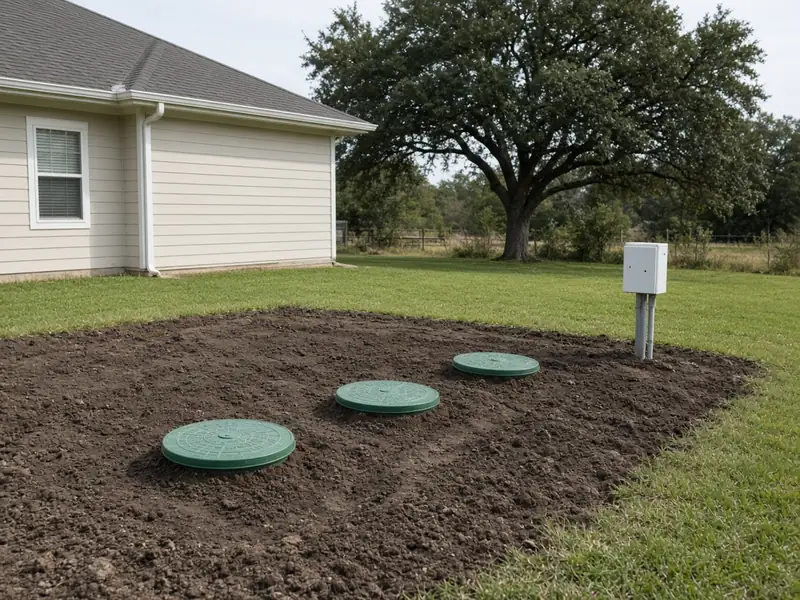
The soil decides. Where soils absorb well and groundwater is deep enough, a conventional septic tank and drainfield may be allowed. Where clay is tight or water is shallow, as on much of the flat land in Waller County, the design is usually an aerobic treatment system.
Lot size
Texas rules set minimum lot sizes for septic systems in many subdivisions, and the minimum is larger when the lot is served by a private well. If your lot is small, ask a site evaluator before you buy.
See the septic cost guide for estimate ranges.
Where we connect you with providers
Waller County, TX · Hempstead, TX · Waller, TX · Prairie View, TX · Brookshire, TX · Pattison, TX
Related services and guides
Aerobic septic systems (ATU) · Septic system replacement · Septic system cost guide · Waller County septic permit guide · FAQ
Get a free septic installation quote
Tell us about the property and the project. Independent local septic installers will contact you with a quote.